
Introduction
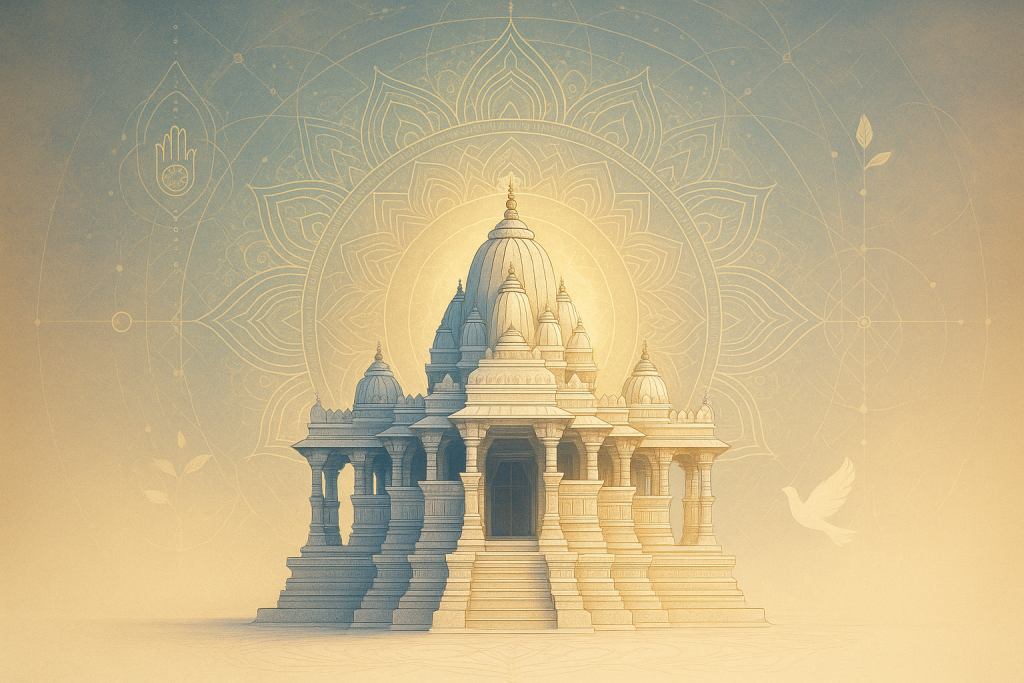
Jain architecture stands among the finest examples of spiritual craftsmanship in the world. Blending mathematical precision, artistic mastery, and deep symbolism, Jain temples reflect the core Jain values of purity, non-violence, and cosmic order. Sacred geometry plays a central role in their design, turning stone into a living expression of spiritual philosophy.
From the marble wonders of Dilwara and Ranakpur to the ancient cave temples of Ellora, Jain architecture embodies a timeless harmony between form, function, and faith.
1. Essence of Jain Architectural Philosophy
Jain architecture is guided by three core principles:
1. Spiritual Purity (Shuddhata)
Temples are designed to cultivate inner peace.
Their serene symmetry and clean geometry mirror the purity of the soul’s journey.
2. Non-Violence (Ahimsa) in Design
Construction traditionally avoided:
- Harm to living beings
- Use of materials obtained through violent means
- Destructive architectural methods
This aligns architecture with ethical living.
3. Cosmic Harmony (Lokakash)
Temples represent the structure of the universe.
Every part—from the base to the dome—symbolizes levels of spiritual existence.
2. The Role of Sacred Geometry in Jain Temples
Sacred geometry is the visual language of cosmic truth in Jainism.
✔ Mandalas & Yantras
Jain temples frequently feature mandalas based on:
- Circles
- Squares
- Multi-petal lotus patterns
These represent the interconnectedness of all beings.
✔ Symmetry & Proportion
Perfect symmetry mirrors:
- Balance
- Non-attachment
- Equanimity
It symbolizes the steady, unobstructed path toward liberation.
✔ The Stellate Plan
Many temples are constructed in star-like patterns (stellate), symbolizing:
- Infinite directions
- Infinite spiritual possibilities
- Expansive cosmic energy
✔ Mathematical Precision
Intricate geometry ensures:
- Acoustic resonance
- Perfect airflow
- Soft, natural lighting
Thus, every architectural detail is functional and meditative.
3. Key Features of Jain Architecture
A. Marble Mastery
Temples like Dilwara are crafted entirely in white marble, symbolizing:
- Purity
- Light
- Spiritual clarity
The carvings are so fine they feel like lace.
B. Carved Pillars & Domes
Jain temples often have:
- Multiple carved pillars (sometimes 1,000+)
- Lotus-shaped domes
- Highly detailed ceilings depicting dancers, flowers, and cosmic patterns
Each pillar tells a spiritual story.
C. Rangamandapa (Assembly Hall)
These grand halls represent community, unity, and shared devotion.
D. Garbhagriha (Sanctum)
The inner sanctum houses a Tirthankara idol, often carved from marble or metal.
Lighting is subtle, creating an atmosphere of serenity.
E. Manastambha
A tall, ornate pillar placed at the entrance symbolizing humility—
a reminder to leave ego outside before entering the sacred space.
4. Famous Jain Architectural Masterpieces
🕉 Dilwara Temples (Mount Abu)
Known as the “marble jewels of India,” these temples display:
- 3D stone lacework
- Floral ceilings
- Unmatched geometric detailing
🕉 Ranakpur Temple (Rajasthan)
Features:
- 1,444 uniquely carved pillars
- A stellar, symmetrical layout
- One of the most complex temple plans in India
🕉 Ellora Jain Caves
Reflect a blend of rock-cut engineering and sacred geometry.
🕉 Shravanabelagola (Karnataka)
Home to the 57-foot monolithic Bahubali statue
—an example of proportion, balance, and sacred monumental scale.
5. Symbolism in Jain Sacred Geometry
Lotus Motif
Represents purity and spiritual awakening.
Wheel of Dharma
Symbolizes progress on the path to liberation.
Infinite Knots & Patterns
Show the eternal nature of the soul and karma cycles.
Tirthankara Iconography
Deep symmetry reflects the enlightened state—calm, balanced, and perfect.
6. The Spiritual Experience of a Jain Temple
Jain temples are designed not just to be seen, but experienced.
Visitors encounter:
- Cool marble floors
- Harmonious silence
- Balanced geometry
- Dim natural light
- Intricate carvings that invite contemplation
The entire environment becomes a living meditation space.
Conclusion
Jain architecture is more than stone—
it is sacred geometry brought to life.
It blends:
- Art
- Science
- Mathematics
- Philosophy
- Spirituality
The result is a timeless architectural heritage that continues to inspire awe, devotion, and reflection.
Standing in a Jain temple is like standing inside a mandala—
a perfect blend of symmetry, beauty, and spiritual depth.